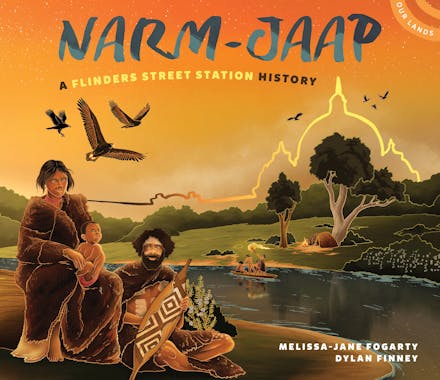
Title: Narm-Jaap: A Flinders Street Station History
Author: Melissa-Jane Fogarty, illustrated by Dylan Finney
Genre: History
Publisher: Hachette Australia
Published: 31st March 2026
Format: Hardcover
Pages: 32
Price: $24.99
Synopsis: An engaging and comprehensive history of one of Australia’s most prominent landmarks, Flinders Street Station, and the land on which it is built.
This is the story of Narm-Jaap.
Flinders Street Station in Melbourne is a modern Australian icon, but the land on which it stands has a long history. We step back in time to when Narm-Jaap was a meeting place for the people of the Kulin nation, and follow along as the land is claimed by the colonisers. We witness Narm-Jaap through its evolution and many forms, but through it all, it remains a bustling epicentre of community and a place of meeting.
Our Lands is an Indigenous history series about Australia’s most iconic landmarks and the land on which they are built.
~*~
The second book on the Our Lands series by Melissa-Jane Fogarty and Dylan Finney is here. This time, they’re exploring the history of the site of Melbourne’s Flinders Street Station, from early pre-colonial days, right up to the current day.
Like the previous book, it takes Australian history and geography as a whole, with key events from pre-1788, and then beyond 1788, or in this case, 1803, when white people first arrived in the area. Bringing Indigenous and white Australian history together in this way shows that there are many things that many of us never learnt at school, that the development of these places may have been more nuanced than previously thought. It introduces Indigenous words, place names and clan names, given a deeper context to what we already know about the well-known places in Australia.
The site of Flinders Street Station has a long history, from its early days as the lands of the various groups that lived within the Kulin Nation, to markets, and finally to the station, first built in 1854, and becoming the station everyone knows in 1910.Like the previous book about Sydney Opera House, this bok shows the varied life of the land of the station, and what everyone knows it as today, as well as the phrases people use in relation to the station. Like under the clocks as a place to meet, for example.
Books like this capture Australian history as a whole, because we should all know every aspect of it, as much as we can and as far as we can to fully appreciate where we live and how Australia has been shaped over 60, 000 years. Because everything is part of Australia and what it has become. Anything that happens in the history of a country has made it what it is, good, bad and everything in between. It is all part of the identity of a nation, and books like this help educate people gently about things they know, things they don’t know and revealing truths or filling in gaps that were woefully ignored in the past.
Thank you again, to Melissa and Dylan for this book that revealed so much to me and hopefully, to many others.
Discover more from The Book Muse
Subscribe to get the latest posts sent to your email.


1 thought on “Narm-Jaap: A Flinders Street Station History by Melissa-Jane Fogarty, illustrated by Dylan Finney”