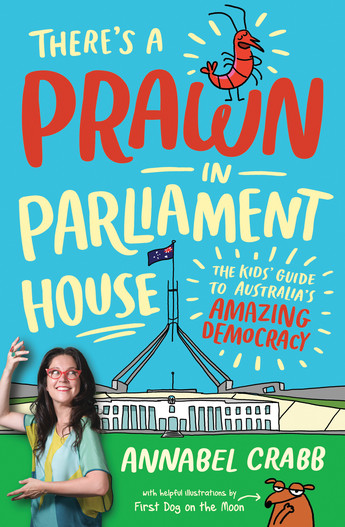
Title: There’s a Prawn in Parliament House: The Kid’s Guide to Australia’s Amazing Democracy
Author: Annabel Crabb, illustrated by First Dog on the Moon
Genre: Non-Fiction
Publisher: Allen and Unwin
Published: 30th September 2025
Format: Paperback
Pages: 240
Price: $24.99
Synopsis: A funny and informative account of how Australia’s democracy works, written by one of Australia’s best-known and most entertaining political writers and documentary makers, Annabel Crabb – host of top-rating ABC series The House, Kitchen Cabinet and Back In Time For Dinner. Helpful and hilarious illustrations supplied by First Dog on the Moon, Australia’s only marsupial Walkley award-winning cartoonist.
Hi! I’m Shawn the Prawn, a 350-million-year-old tiny coral fossil that lives in the floor of the grand Marble Foyer at Australia’s Parliament House. Sharing a house with a democracy is awesome because Australia’s democracy is unique and it totally rocks.
Every three years, Australians come together on a Saturday to elect a government. We do this because having a government is the best way for large groups of people to live in peace and enjoy things like roads and airports and hospitals and delicious food without having to personally arrange all the boring stuff. But how do we elect a government? How does the government make decisions? And what is so special about our system of democracy?
Political writer and commentator Annabel Crabb explores, explains and examines Australia’s unique democracy from the smallest shrimp to the largest coat hanger with help from Guardian Australia cartoonist First Dog on the Moon.
An earlier version of this review appeared in Good Reading Magazine in November 2025.
~*~
In this fantastic book, Annabel Crabb and the First Dog on the Moon bring Canberra and Parliament House to life for younger (and older) readers. Everyone goes to Canberra at some stage in school to learn about Parliament, we usually learn about civics and citizenship at school, and at 18, we’re all eligible to vote in compulsory elections. But have you ever wondered about the intricacies of the processes of laws and parliament, the people and the places, and how it all happens behind the scenes? What we see in Question Time, during election campaigns and all the fluffy stuff or the outcomes, laws and other stories that make it into the public have a lot going on behind closed doors.
Annabel Crabb, ABC journalist and host of the Chat 10, Looks 3 podcast takes all this complicated information and distils it into a short book for ages ten and over so they can understand how our democracy works. It highlights how things worked in colonial times, acknowledges that Indigenous people had their systems, and then goes into how things developed during colonial times and the 1850s into the secret ballot system we use today, as well as touching on significant developments.
Her clever and insightful explanations are coupled with illustrations from First Dog on the Moon, and readers get a good explanation of the Westminster system, which is what our Parliament is based on, the House of Representatives and the Senate, and all the complicated things they have to do. She’s accompanied by the prawn in Parliament House to explore, explain and navigate the centre of Australian democracy in Canberra.
Yes, we have a prawn in Parliament House. Don’t worry, it’s a fossil, and you can find it in the floor of the Marble Foyer, encased in some Belgian black limestone. Everyone knows the basics of our democracy: everyone over 18 votes every three years, and the history of how we got to this focus is interesting, complicated and fraught. Think about the suffragette movement that got white women the vote in 1902, the long road to recognising Indigenous people and them getting the vote in the mid-twentieth century. And all the referenda and other votes we’ve had about conscription, taxes, and becoming a republic. Annabel has taken all these facts and simplified them so anyone can understand it. It’s a useful book because it gives a great insight into how democracy works.
Here, we can also see how different people in Parliament play their role in democracy. From the Prime Minister to the MPs, the role of the Opposition, and the other people that help keep democracy running. And remember, check the colour of the carpet! Red for the Senate, green for the House of Representatives, and blue for the Executive Wing. If you hit the blue carpet, you’re definitely in the wrong place for the public.
Explore how laws are made with a quirky example from Annabel, the process that took us from public voting where people could buy votes with a beer or pie to the secret ballot we use today. It’s all about helping people understand the system, because let’s face it: it can be very complicated and sometimes, the first step we need is a book like this before exploring the rest of the system in depth. Annabel is very good at making it all understandable, and ensures that readers of any age will appreciate it.
Many kids have headed off to Canberra in year six for a trip to see how our grand democracy works. This book is the perfect companion for a trip like this, and I have dipped in and out of it for some my own research for Guide Dogs recently. It’s entertaining and informative, and I can’t wait to see it go flying in the world.
Exploring and understanding our democracy is important, because we all, or we all should, benefit from the laws and processes the government puts into place. As a starting point, and for a good understanding, I found this to be insightful and amusing. Anything that could be a little boring is always more fun when it’s written in an amusing way. Annabel Crabb does this well with her commentary and adding in a few fun and interesting facts along the way. This informative book is fabulous and suitable for all readers.
Discover more from The Book Muse
Subscribe to get the latest posts sent to your email.

 The Book Muse
2 thoughts on “There’s a Prawn in Parliament House: The Kid’s Guide to Australia’s Amazing Democracy by Annabel Crabb, illustrated by First Dog on the Moon”