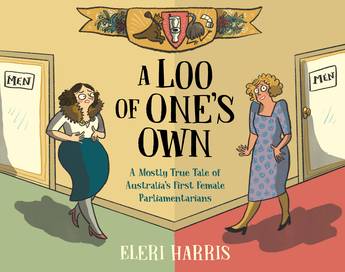
Title: A Loo of One’s Own
Author: Eleri Harris
Genre: Non-Fiction, Humour
Publisher: Allen and Unwin
Published: 3rd June 2025
Format: Hardcover
Pages: 40
Price: $26.99
Synopsis: The fascinating (and sometimes hilarious) story of the first women elected to federal parliament and the rather pressing issue they discovered on their first day on the job: there were no women’s loos in Parliament House!
In 1943, the first two women were elected to the Australian parliament. Enid Lyons and Dorothy Tangney had very different political views, but they soon discovered they had at least one problem in common: none of the loos for elected officials in Parliament House were marked ‘Ladies’.
Award-winning cartoonist Eleri Harris tackles an important moment in Australian history in a humorous and lighthearted way, illuminating themes of equality and accessibility for readers of all ages.
~*~
Did you know that Australia elected its first female federal parliamentarians in 1943, but despite women working at Parliament House in other roles, there were no toilets for women until 1974?
This is what Dorothy Tangey and Edith Lyons faced when they started working at Parliament House in the midst of the Second World War, and a time when women’s toilets in public weren’t all that common. So when the time came for them to use the facilities, the two women from different states and different political persuasions found they had something in common: a lack of a place to relieve themselves.
Eleni Harris, an award-winning cartoonist has used her talents to tell the (mostly) true story of Enid and Dorothy, and how women between 1943 and 1974 fought in various parliaments and made statements – like putting their shoes outside the men’s toilets to indicate women were in there to finally get women’s toilets installed. Given women already worked there as tea ladies, cleaners, and secretaries, it was confounding that there wasn’t already something in place, or that women had to go home to use the toilet. This event in 1943 sparked a decades long campaign that worked to do something towards equality, even as more and more women were getting jobs in the public sphere, but their needs were not being met.
One would think that parliament would be a crucial place to have these facilities, but as Eleni shows in her book, the men and people in charge didn’t think the women would need them or even get to parliament – perhaps a presumptive or prevailing attitude at the time. But one that didn’t suit the fact that these women – Enid and Dorothy and all the women in supporting and administrative roles, didn’t have toilets they could access easily. What the attitudes shown in the book illustrate is how things even just a few decades ago ignored the role of women in public, but assumed that there would be times they would be there. And yet, going to the loo when out was something that women had to fight for, just as they fought for the vote a mere forty years earlier.
The book doesn’t go too much in-depth, but touches on the issue and explains that whilst it isn’t known if Enid and Dorothy used the shoes outside the door tactic to use the men’s loos, women in other parliaments did, which is what eventually led to toilets being built for them in 1974. It’s also a story about access – and what happens when access feels conditional, or like it is an afterthought. Because it didn’t make sense that there was a distinct lack of women’s toilets but that women were employed in support and administration roles back then.
There is an informative timeline at the back of the book about women in parliament and public life, including a fact that women were only fully included on juries in Victoria and NSW in 1977 once ‘adequate toilet facilities’ were added to court rooms. That’s only 48 years ago! Two generations! Imagine if this access and other forms of access had always been built in – would women have had to fight for their own toilet in a public building like Parliament House? We’ll never know but it is important to know how long it took for this to happen. That women were in jobs in places where they may not have had access to facilities throughout the day.
This is a serious topic but presented in a fun and accessible way for readers aged five and older, because it may not be something people have ever thought about. History has many layers and hidden stories, many things that are not common knowledge but that we should know more about. We need to know more because they tell the story of Australia through the good and the bad, or the stuff that people may not have wanted revealed for whatever reason.
And books like this are the perfect starting point to do further research, because the author does state that she melded a few things to make the story work and have impact. But it boils down to the facts of Enid and Dorothy’s experiences, and how they led to the eventual and very long journey to get women a toilet in Parliament House. And the important work they have done to forge a path for women in government as well. A great book that I am sure has many more stories behind that would be very interesting to discover.
Discover more from The Book Muse
Subscribe to get the latest posts sent to your email.

 The Book Muse
10 thoughts on “A Loo of One’s Own by Eleri Harris”