
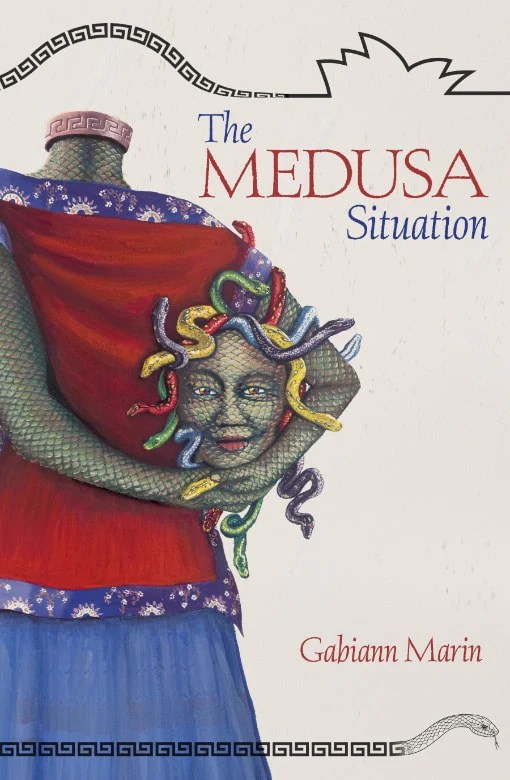
Title: The Medusa Situation
Author: Gabiann Marin
Genre: Fantasy
Publisher: Clan Destine Press
Published: 1st July 2024
Format: Paperback
Pages: 250
Price: $36.95
Synopsis: The Medusa Situation joins the Greek goddess Hera and her Olympian family as they accept their forced divine retirement and live out their immortality in the Aussie suburbs.
Their once exciting, all-powerful, and totally worshipped lives have been replaced by endless days of quiet resentment and mystical reality TV programs.
That is until the day Stheno and Euryale, sisters of the more infamous gorgon of legend, turn up on Hera’s doorstep asking for help because Medusa’s head has been stolen. Again.
In a race against time Hera and her stepdaughter, the goddess Athena, join forces with a rag tag bunch of ancient Greek deities and mystical creatures to find the culprit and recover Medusa’s head before it creates havoc across the mortal and divine realms.
The novel is Janet Evanovich meets Natalie Haynes, in an entertaining urban fantasy which examines issues of justice, male entitlement, and the ways in which powerful women have been treated throughout the history of storytelling.
It’s mystery, mayhem, mythology, comedy, and social commentary with a feminist twist in Gabiann Marin‘s The Medusa Situation.
~*~
For millennia, the Greek Gods, particularly the Olympians, were favoured and worshipped. Then the Romans, monotheism, science and reason crept into the world, and now, the Olympian gods are retired and living in the suburbs of Australia. They could be living next door to you – you never know!
Yes, Hera and womaniser and utterly useless Zeus are living sort of peacefully in the suburbs of Sydney on existence points they withdraw from the Trove when they need things. Some gods help run the EBCU and the Courts of Lore that keep the various gods and mythical creatures from all sorts of pantheons and myth cycles in line (when they can), whilst Hera spends her days watching mystical reality TV, and generally snipe at Zeus. Zeus, who refuses to do anything and expects Hera to pick up after him. So, when gorgon sisters, Stheno and Euryale show up, Hera seems glad of the distraction, of something to do.
Their sister, Medusa, has lost her head again. Literally. It has been stolen, and only someone involved in the mythical world and realms could have done it. And there’s a time limit on this – Medusa has lost her head so many times, that it is getting to the point where the longer Medusa’s head is separated from her body, the more likely she’ll become human again. Or create havoc everywhere the head goes.
Hera must team up with her stepdaughter Athena and a rag-tag team of Greek deities. They all have different motives, but one thing is clear: everyone seems to have a beef with Zeus. They have one goal: recover the head before it can wreak havoc in the mortal and mythical worlds.
Mythology retellings take many forms, and there have been several lately that are putting a feminist bent on the original myths. Many of them are told from the perspective of the female gods and mythical figures, the goddesses and heroines often sidelined or whose stories might have been hidden. Justice and whose stories are allowed to be told are at the heart of this novel, and Hera is wonderful. The vengeful goddess whose husband spread his seed around willy-nilly is over pandering to him, and this reverberates through the novel as she works with other goddesses who have often borne the brunt of the entitlement of the gods they accompany.
It examines and interrogates the polarity and binary roles women were given as either monsters or powerful yet innocent in many ways. From Demeter and Persephone, the mother and daughter torn apart by Hades to Medusa, the woman cast as a ferocious monster with snakes for hair. She is victim and aggressor in mythology, a tragic figure who has been thwarted be Perseus many times in the timeline of this novel.
Female-centred retellings like this are often complex, showing that the goddesses often have deeper stories than we know, and motivations that have shaped them. Gabiann has made them human as well. They’ve got emotions, they need to unpack years of dealing with men and gods who don’t seem to have a care in the world, or who seem to have always managed to get away with just about anything. It’s plagued Athena, Artemis, and Hera for thousands of years, and now, they’re empowered. Exploring mythology and how it operates through a modern lens is interesting, as it gives a whole other glimpse into what the world of these mythical beings is like. We’re allowed to see them being messy and human in this novel, allowed to see their flaws.
Flaws that reveal that they’re not as perfect as the myths portray them as. Flaws that indicate they’re definitely infallible, and that perhaps some of them can actually be quite useless when it comes to practical life. Or the relationship flaws that come to light in the human world, where the women are navigating a new reality, a reality where they can speak up and be empowered. It’s a quest to find Medusa’s head and stop it being used for nefarious means, and a journey that traverses the mythical realm and the real world to find the head. I enjoyed the reclamation of power and space the goddesses had, allowing them to explore their emotions and let those around them know what had really been happening for millennia. Some of the gods were simply oblivious and didn’t realise what their counterparts were feeling, and there were some who came across as more likely to listen and learn. This allowed the characters to grow and change, and accept things. I loved the openness of the goddesses in this book, and that they were allowed to vent. There was good growth for several male and female characters, for the most part with lots of moments of hilarity throughout the novel.
This is a novel that explores social and societal change through the lens of Greek gods and goddesses who have seen a lot. Its feminist lens highlights the inequities that exist not only in society, but also in myth cycles, and what we perceive based on what we read and whose voices are heard. Who gets to speak is a key element in this novel as well, showing that everyone should be able to have a voice, but nobody should speak over the experiences of others.
I enjoyed this intriguing retelling of the Greek myth cycle, and think it works well to deliver what it promises to readers.
Discover more from The Book Muse
Subscribe to get the latest posts sent to your email.

 The Book Muse
Great review! I have a copy of this, and am looking forward to reading it shortly.
LikeLike
Thank you!
LikeLiked by 1 person