
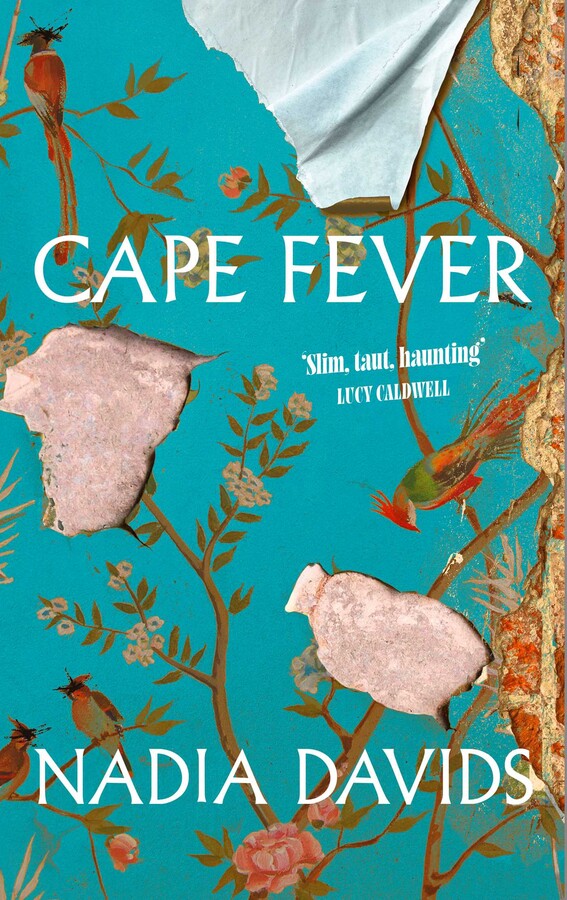
Title: Cape Fever
Author: Nadia Davids
Genre: Gothic, Historical Fiction
Publisher: Simon and Schuster/Scribner UK
Published: 30th December 2025
Format: Paperback
Pages: 240
Price: $29.99
Synopsis: An exhilarating tale of twisted desire and the unexpected shape of revenge, for readers of The Safekeep
‘I come highly recommended to Mrs Hattingh through sentences I tell her I cannot read.’
1920, a small, unnamed city in a colonial empire. Soraya Matas believes she has found the ideal job as a personal maid to the eccentric Mrs Hattingh, whose beautiful, decaying home is not far from the Muslim quarter where Soraya lives with her parents. As Soraya settles into her new role, she discovers that the house is alive with spirits.
While Mrs Hattingh eagerly awaits her son’s visit from London, she offers to help Soraya stay in touch with her fiancé Nour by writing him letters on her behalf. So begins a strange weekly meeting where Soraya dictates and Mrs. Hattingh writes – a ritual that binds the two women to one another and eventually threatens the sanity of both.
~*~
In 1920s Cape Town, or a place that is like Cape Town, Soraya Matas us about to start a new job at a big house near the Muslim Quarter. It’s supposed to be an ideal job – a personal maid to Mrs Hattingh, an English woman who has raised her son in the Cape and lost her husband in the Cape. Her son lives in London in the post-war years, and after the world has been ravaged by the Spanish flu. Soraya is loyal to her faith, to her family and to her employer but Mrs Hattingh’s demands and assumptions start to take their toll on Soraya. And she’s aware that the home on Heron Place is filled with ghosts of maids and paintings.
Soraya is busy preparing for a visit from Mrs Hattingh’s son when her employer offers to help her stay in touch with Nour, her fiancé. Yet, something feels off. Throughout the book, there is always a feeling of everything being on edge, of secrets and cover-ups. Soraya’s keeping things back too, if only because it is what is expected of “her people” as Mrs Hattingh keeps saying. She seems to praise Soraya and what she does, how she and her family have adapted, but it feels like a sideswipe. A compliment without actually being a compliment to maintain the racial and class prejudices that shaped the world of the book and may attitudes at the time.
Whilst the colony and country are well established by the time the book starts, the echoes of imperialism and supremacy are still there. And we learn about the effects of these through Soraya’s narration, and hints at early 20th Century at least through Mrs Hattingh. The First World War looms large in this book, and shapes much of the history that has led to the situation the characters find themselves in. When first starting this book, it feels normal, or at least like it might be a story about exploration of identity. But get a bit further along, and the gothic threads start to emerge. One of the house’s ghosts becomes a big presence, linked to a strange painting that haunts the characters. And it’s unclear what Mrs Hattingh’s motives are, because she tells Soraya about the letters Nour writes, rather than reading them out or allowing Soraya to read them. Is she also taking Soraya’s words and twisting them?
Something feels off throughout the novel, something building towards an event that will alter the way the house and the people living in it relate to each other forever. There’s tension tugging at the edges, twisting truths and beliefs, turning what was meant to be a dream job into a world of control in the home of a lonely woman, unable to accept the truth about what has happened to her family. Soraya’s narration shapes the story, and her intuition about ghosts and the otherworldly themes hints at what is to come throughout the novel. And it is clear that what Mrs Hattingh is expecting to happen with her son will not. Nobody else ever speaks of him, and there’s so much shrouded in secrecy, guilty or embarrassment. A reflection of the times the book is set in perhaps. The shame of not wanting to admit the truth when faced with the reality from others in similar positions? There are several questions and threads that are filtered through two divergent yet powerful perspectives.
It also explores the divisions based on race and religion, the different areas someone lived in based on these factors, and the attitudes that shaped an apartheid country. I felt that Mrs Hattingh thought she had Soraya’s best interests at heart, but she really wanted to control her world and everything, and everyone in it. She didn’t want to acknowledge that someone she saw as beneath her could, for example, read. It was superiority as well, shown through her words and attitudes that reflected her upbringing and understanding of the world.
All of these aspects combine to create a clever gothic novel, with a strong voice that reflects the diversity of the world and South Africa, and shows readers that everyone’s experiences shape who they are and end up becoming. It’s deeply reflective and put together well that brings everything together effectively and evocatively.
Discover more from The Book Muse
Subscribe to get the latest posts sent to your email.

 The Book Muse
4 thoughts on “Cape Fever by Nadia Davids”