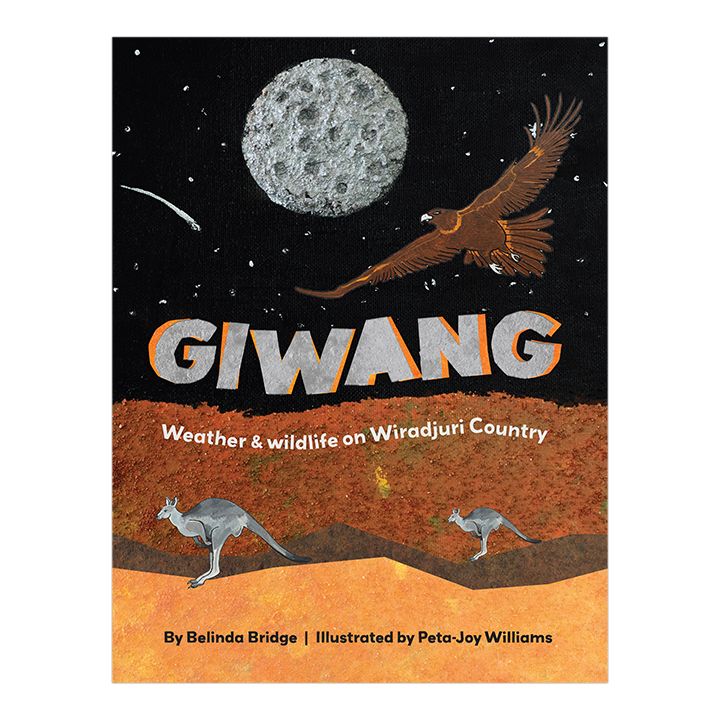
Title: giwang
Author: Belinda Bridge, illustrated by Peta-Joy Williams
Genre: Language and learning
Publisher: Aboriginal Studies Press
Published: 1st November 2025
Format: Paperback
Pages: 32
Price: $24.99
Synopsis: The dry central western region of New South Wales is Wiradjuri Country. Here, the landscape slips from one weather cycle into another as hot, dry and windy times soften into crisp chill.
Meet the animals you can find on Wiradjuri Country in this intricately illustrated introduction to the Wiradjuri Language by two Wiradjuri creatives.
In giwang, Wiradjuri animals are shown along with Wiradjuri Language and English translations. Belinda Bridge’s words weave an unpredictable cycle onto the page against beautiful paintings by Wiradjuri artist Peta-Joy Williams.
This evocative resource speaks to readers of all ages. It is rich with cultural meaning and is a significant Wiradjuri title to add to bookshelves everywhere.
~*~
The informative and engaging book, giwang, is about the words and phrases used to describe the weather cycles in the Central Western region of New South Wales, also known as Wiradjuri Country. Here, you can meet the animals that call Wiradjuri Country home, and this is a glorious, illustrated introduction to Wiradjuri language by Belinda Bridge and Peta-Joy Williams. This is a chance for people to learn something about an Indigenous language, and it’s a good start, because animals and weather are things that everyone has some kind of experience with or that we at least know something about from things we have done, things we’ve watched or things we’ve read.
It starts with an Acknowledgement to Country in Wiradjuri language, cementing its significant place in sharing knowledge and bringing Wiradjuri knowledge to everyone, to share and educate. Did you know that unlike the European weather system that acknowledges four seasons, the Wiradjuri Cycle has six seasons? There is a brief explanation about this in the book, and notes that the months mentioned, and how they relate to the seasons are just a rough guide. So, it starts off well, positioning this as an accessible and educational book that everyone can get something out of.
Each season and the months they relate to, as well as the types of weather that might be experienced at those times are repeated in between the animals featured. Seeing how the seasons and months can cross over was interesting, because we can all feel the changes and differences, and we all experience the way different seasons and months work. Or how they can change in the blink of an eye from one day to another. The Wiradjuri descriptions, translated into English, give a good indication of these varying differences as well as what we might typically expect.
October and November, for example, can be described as wugil, which translates to hot and windy. Or galing-galing bu niganagaby ganhang-giri, which is wet and hot, and becoming warm, which in this book was attributed to months like December, January, February and March at different stages. Showing how different seasons can cross over different months and change is illustrates how Indigenous Australians understood the weather and changing seasons and saw the differences at different times. Making this accessible helps readers understand the cycle and learn a new language – perfect!
At the same time, in between the seasons and observations about how they relate to the months we use, are the various animals like the garru (magpie), waagan (crow), and barrandhang (koala). I felt like it made the Wiradjuri language and how they understood the seasons accessible for readers of all ages, which means finding out more about Indigenous people, in this case Wiradjuri people, makes books like this easier to find, and it gives Indigenous people and languages good representation. Not only does it give the English translations in the text, but there is a handy glossary at the back which reiterates the words and language. When learning any language as a second or additional language, setting things out this way is accessible and a great learning tool.
And there is a handy note that talks about what I mentioned above. That the Wiradjuri cycles don’t have a set pattern, that they can move and blend. This makes sense given how we are all currently experiencing climate change. So, giwang is a brilliant introduction to the six weather cycles that people experience on Wiradjuri Country, and the animal seen there.
Experience fantastic Wiradjuri art by Peta-Joy Williams in a fabulous language and weather resource for primary schools, children and language learners. And the best thing? This book, giwang, has been written be a Wiradjuri Language teacher who loves sharing her language. Belinda’s words are accompanied by detailed illustrations by Peta-Joy Williams, who has used paint mixed with sand and water from Wiradjuri Country to create them. It’s what gives the images the wonderful textures and brings them to life to welcome everyone to Wiradjuri Country as Peta and Belinda share cultural and language knowledge.
Discover more from The Book Muse
Subscribe to get the latest posts sent to your email.

 The Book Muse
3 thoughts on “giwang by Belinda Bridge, illustrated by Peta-Joy Williams”