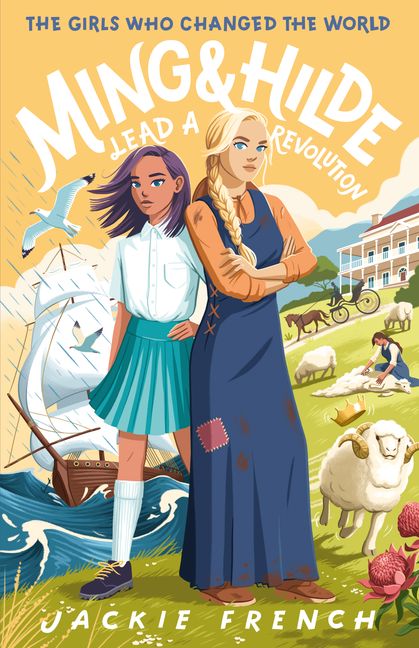
Title: The Girls Who Changed the World: Ming and Hilde Lead a Revolution
Author: Jackie French
Genre: Historical Fiction
Publisher: HarperCollins Australia
Published: 7th June 2023
Format: Paperback
Pages: 336
Price: $16.99
Synopsis: The third book in the best-selling Jackie French historical series that places girls centre stage.
Ming Qong is convinced that girls have changed history throughout the world.
She’s faced danger and adventure when Herstory sent her to the past to witness girls’ bravery in the incredible feats left out of ‘histories’. Now Ming asks Herstory for another time-travelling quest – this time, one that is less confronting.
Ming finds herself in relative luxury, heading to an unknown destination on a ship carrying royal Saxon sheep, travelling with the girls who care for them.
What do female shepherds have to do with history? And is it even possible for sheep to be royal?
As Ming knows only too well, change is never easy, so how can one girl – and a sheep – change the world?
From one of Australia’s favourite authors comes an inspiring series for all the young people who will, one day, change the world.
~*~
Ever since meeting Herstory, Ming has witnessed girls changing the world, from the suffragettes in the 1890s, to war-torn France in 1916. Ming wants another, less confronting sojourn into the past, so Herstory sends her back in time – to a ship with royal Saxon sheep and a Saxon girl called Hilde and her friends, who are caring for the sheep on the journey. Ming soon ends up in the 1840s, in the colony of South Australia. On this journey, Ming learns that her name on this sojourn into the past is Elizabeth White, destined to be a governess for Mr Montjoy’s son Edmund. But it is Hilde’s presence that shows Ming that girls will change the world again – not as dramatically as before and in very different ways to Ming’s previous adventures, but nonetheless, Ming’s desire to see another change but in a safer, and more comfortable way is granted. Yet again, Ming grapples with racism, sexism, and assumptions about her role in society and the household, as well as the interactions, or lack of interactions and understanding by the white settlers and the Indigenous people in the decades before the colonies of Australia federated.
Yet again, Jackie French centres the stories of women and girls, and this time, she ensures that the Montjoys form a connection with Hilde over sheep and care for sheep, and the distinct voices of the Saxon girls who are dedicated to staying with their royal sheep (or sheeps as Hilde says). Hilde is a passionate character – passionate to move to a new place, passionate about looking after Wusty and the other royal sheep, and passionate about how the sheep should be treated and shorn. We all know the song ‘Click go the shears boys,’ right? Maybe it should be ‘Click go the shears, girls,’ – as it is Hilde and her friends who teach the shearers of Montjoy in this novel about shearing sheep and caring for them to help build the wool business Mr Montjoy is embarking on in the new colony of South Australia, settled by free men instead of convicts. It is a new adventure to Ming, one where she has to fit in, and not be a woman who speaks her mind, though I did feel that Montjoy delighted in her curiosity and in the forcefulness of Hilde. He was in the company of women who spoke their minds and one who shared his interests, so it suited his character to want to listen to Hilde rather than letting his shearers take over.
I liked that this book showed the hidden history of sheep shearing – a topic that people might not often think of exploring in fiction, but because it has been such a big part of Australia’s post-1788 history, it made sense to explore it further and show the role that women played in how the wool industry, the shearing economy and techniques where shaped. And yet, women like Hilde and their role in this were erased once Australia went to war against Germany in 1914, and overall, the work of the women has gone unacknowledged, or ignored until now. Hilde’s story introduced me to this revolution – the change in how sheep care and the wool industry was changed in South Australia in the second half of the nineteenth century. I enjoy reading these stories that bring the hidden stories, the stories that were ignored, hidden, erased, or even repressed for such a long time to life. We need to know more of these stories, the real ones and the ones that inspire fiction across a range of genres and audiences because they are stories we all need to know. They are stories and people that many of us didn’t get to learn about in history lessons because they were not included or mentioned – or even mentioned in history books at times. All of these hidden stories created our history – and they should all be told in some way and made accessible to everyone so the entirety of Australia’s history can be shared with everyone.
I am always going to read a Jackie French book – perhaps because she tells the hidden stories so well and manages to balance historical attitudes and contemporary understandings so well. And not just through Ming – we can see in her other stories how her characters have an understanding of various issues that are tackled within the scope of the historical setting with a modern sentiment that illustrates what the attitudes were during the time a book Jackie writes is set, and ensuring that readers understand the division present and how people at the time worked against the biases that are still present today where we use different, more up-to-date language to talk about them. I think this makes Jackie French’s books as good as they are, and as popular as they are – the amount of research she does, the care she takes to avoid being offensive whilst still reflecting the attitudes of the time, and the way she ensures unheard stories are given the voice that they have always needed, putting those written out of history back where they should have been all along in the history books. I am thoroughly enjoying the Girls Who Changed the World series and am looking forward to seeing where Ming goes next.
Discover more from The Book Muse
Subscribe to get the latest posts sent to your email.

 The Book Muse
8 thoughts on “The Girls Who Changed the World: Ming and Hilde Lead a Revolution by Jackie French”