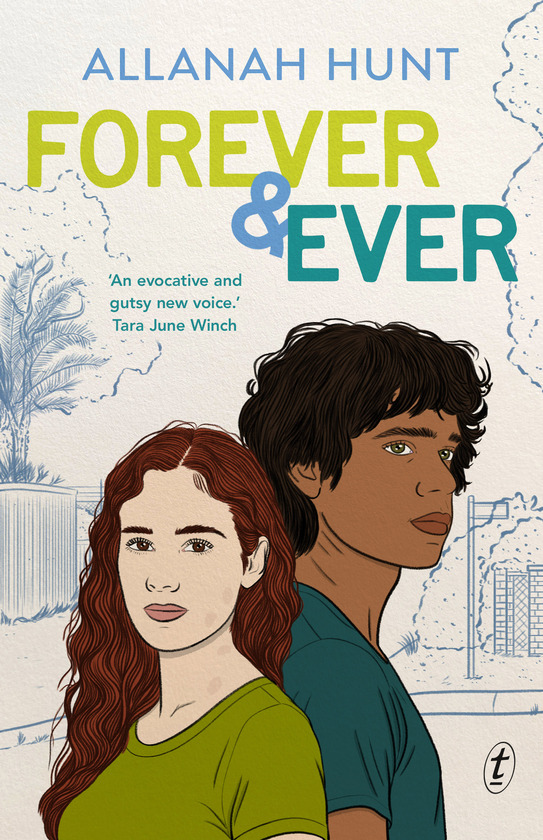
Title: Forever and Ever
Author: Allanah Hunt
Genre: Contemporary
Publisher: Text Publishing
Published: 3rd March 2026
Format: Paperback
Pages: 320
Price: $22.99
Synopsis: Talia is sixteen, pregnant and angry. Her family is broken. She’s looking after her unwell mother. Her dad’s gone. At school she is shunned. And Johnny—the one person she thought she could count on—just walked away.
Johnny is Barkindji, smart and confused. He’s struggling with the weight of his parents’ expectations: he wants to please them, but is the future they’ve planned for him the one he really wants? He makes a decision he knows he’ll regret: leaving Talia behind.
But some love—no matter how impossible—never lets go. Forever & Ever is a gritty, heart-wrenching love story set in a Murray–Darling river town simmering with deep seated prejudice and long-buried secrets.
Allanah Hunt is a proud queer Barkindji and Malyangapa woman, and a lecturer at the University of Queensland. Her short stories have been shortlisted for various awards. Forever & Ever is her first novel. Allanah lives in Brisbane.
How did the idea for the book originate?
When I was 18 years old, I had a dream I was pregnant and that both my parents refused to support me, and both wanted me to have an abortion without consulting me about what I wanted.
That was the initial kernel that started the story, but it evolved so much. Some of the racialized issues discussed in the novel, like Talia’s parents not wanting a Blak baby, is loosely based off my parents’ love story, where my white mother was shocked by the discrimination directed at her and my Indigenous father, where certain family members didn’t want her to ruin her bloodline by having Blak children.
What would you like readers to take away after reading your book?
- That having privilege doesn’t make you an inherently bad person, whether that is white privilege or other forms. The danger comes when we don’t want to confront that privilege and unquestioningly engage in systems that we know only benefit us and discriminate against others.
- I want readers to understand the continued racisms faced by Indigenous people within Australia, whether that is micro-racisms at school or danger of being victim of a hate crime, with institutional racism by the police. I also want readers to understand that while interracial marriages are no longer illegal, that doesn’t mean white families still don’t subscribe to the idea that Blak blood will damage their next generations.
- I want readers to come out understanding the importance of properly supporting teens in their dreams and their needs, whether that is listening to what your kid wants to do with his life, or something much larger, like a teen pregnancy.
- I want to contribute more books that show Indigenous peoples in positive roles in life and Indigenous culture being seen as valuable, not just deficit.
~*~
Meet Talia. She’s sixteen, dealing with a less-than-ideal homelife, pregnant and caught between family and societal expectations and judgement. She’s white, and her ex-boyfriend, Johnny, is Aboriginal. They’re both on different paths. Talia’s family has very few expectations for her to succeed. And Johnny’s parents seem to have his life beyond high school in Murder Gully, a community on the Murray-Darling, all planned out for him.
Nobody factored a surprise baby into the mix, and everyone seems to be able to make decisions about the future except for Talia, who longs to work things out and please everyone. Within their community, there is judgement about Aboriginal people in the community, racism that assumes things about Johnny and his Barkindji family that aren’t true.
It’s a town that refuses to see past the racism and judgements. But Johnny and Talia are willing to confront this and confront their own misunderstandings and biases to get to know each other better. Talia is willing to listen to Johnny; to read the books he gives her by Indigenous authors. And she’s doing what she can to confront her own privilege, to question why there are people that don’t trust certain people. It’s a long journey for her, and one that she and Johnny acknowledge is going to take time.
The novel is split into Talia and Johnny’s perspectives. Talia’s explore the pregnancy, the decisions she makes and how people treat her and react to her decisions. Johnny’s chapters build up to the pregnancy from the start of their relationship, and throughout the pregnancy. It’s significant as it shows how both of them are on their own journey, and it reflects how society can treat teen mothers.
It’s a vastly different experience for Talia, who has to deal with all the decisions, all the changes to her body, and everything else that goes with the pregnancy as she tries to navigate the new life. Whilst Johnny gets to get on with his life, but is still faced with discrimination.
Allannah Hunt’s new novel explores how discrimination happens in so many different ways, and leads to discoveries that impact Talia and Johnny’s families, that reveal how people need to confront the past and work together to move forward and learn how to get along. At least, that’s what it felt Iike to me. It’s about seeing that racism isn’t just about blatant laws or attitudes, but it’s about the little things. The sideways glances. The comments that might sound innocuous but in reality, they’re not.
And it’s about supporting teenagers, whoever they are to achieve their dreams. To become who they want to be, and to face the world as they need to. Because Talia represents the teens who don’t get the support they need because they’ve spent too much time being that support for someone else. And for Johnny, it’s about telling the truth, showing his parents that he wants something different than they envisaged for him. We need to acknowledge that this is okay, for anyone.
I felt for Talia and Johnny as they grappled with what other people wanted for them, or expected from them based on their age, race and gender, because these felt like the biggest factors in how they got support. It was lovely that Talia’s support came from somewhere least expected. I think the way things came together and evolved was lovely, and I was proud of the strength Talia seemed to have, and her ability to work out when she needed to ask for help. I think this was a lovely book about found family as well, and that when we work together, we can make the world a better place.
Discover more from The Book Muse
Subscribe to get the latest posts sent to your email.

 The Book Muse
1 thought on “Forever and Ever by Allanah Hunt”