
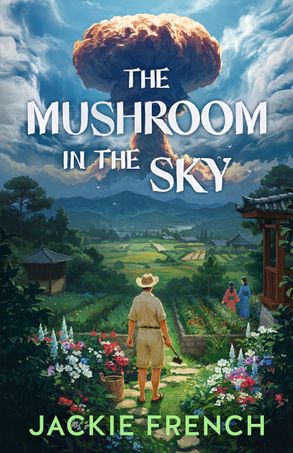
Title: The Mushroom in the Sky
Author: Jackie French
Genre: Historical Fiction
Publisher: HarperCollins Australia
Published: 2nd July 2025
Format: Paperback
Pages: 240
Price: $17.99
Synopsis: In the 80th anniversary year, Jackie French explores the dropping of the bombs at Hiroshima and Nagasaki in August 1945, which ended World War 2.
1942
Japan has bombed Sydney Harbour. Sixteen-year-old Ossie lies about his age to protect his country, even though it means abandoning his only family, a one-eyed dog named Lucky.
Kind-hearted Mrs Plum is already looking after forty-six dogs belonging to soldiers who’ve gone to war. She can’t possibly care for another. But just when she’s becoming desperate to find a way to feed them, help arrives: thirteen-year-old Kat Murphy volunteers to care for Lucky and persuades the girls at school to help, too.
As Kat and Lucky grow closer, Kat realises he can still see Ossie, the master he loves. And somehow, Kat and Ossie catch glimpses into each other’s lives, too. This extraordinary connection helps Ossie survive when he is taken as a prisoner of war to Japan. There, he witnesses a strange mushroom cloud rise above Nagasaki – the result of a bomb that will take, save and change lives, and forever leave the question: was it worth it?
Taken from eyewitness Japanese accounts of that extraordinary but often misunderstood time, this is a story of quiet heroism and endurance in the face of an unimaginable horror that continues to resound to this day.
~*~
It’s 1942, and the world is at war again. In the lead up to the novel, Japan has bombed Pearl Harbor, Darwin and Sydney Harbour. Kat has been packed off to the south coast to live with her aunt and uncle, and is going to a new school. One where she doesn’t fit in. She’s helping Mrs Plum, a local woman who has taken in forty-six dogs whose masters are away at war, and have nobody else to turn to. Kat is thirteen at the start of the novel, and she meets Ossie, a sixteen-year-old orphan who has lied about his age to sign up to fight. He hates the idea of leaving his beloved dog Lucky, but Kat, who volunteers with Mrs Plum, takes him in. Ossie reluctantly agrees, and heads off to war in the Pacific.
Ossie has a special connection with Lucky – they can tell when the other one is lonely or hurting, and this connection is threaded throughout the novel. Kat is able to see or sense what is happening to Ossie in the war through Lucky, catching glimpses into his life at war just as Ossie catches glimpses into her life. All through a very special dog, who loves both his masters, and is loyal to Ossie. The first quarter or so of the novel is dedicated to setting up Kat and Ossie’s journeys in war and on the home front as it leads into the bombings of Hiroshima and Nagasaki, and the devastating fallout of the atomic bombs. Communities and entire cities are destroyed, people die and fall ill, and those left behind do their best to bring comfort to anyone left alive as the war draws to a close.
2025 is the 80th anniversary of World War Two and the destruction of two Japanese cities, where the human stories are not often heard. Where we know when the bombs were dropped, how many people died and that people got sick or had long-lasting illnesses as a result. Ossie’s story peals back the layers on the human stories using eyewitness accounts of those awful days and the days that followed, using records and diaries available to piece together what happened and how ordinary people were affected by this time. How a shift in beliefs and attitudes altered how a country known for its respect was viewed and treated. And uses the idea that different experiences highlight the complexities of war. Because there are always questions of morality involved about combatting violence with violence, the need to defend your country, and how innocent people who didn’t ask for war. For whom honour and decency are part of their culture, not the army and military that comes across as cruel.
It’s a very human glimpse into a horrific time, and what led to the end of the war in the Pacific, and the lengths people felt they had to go to. It shows that there are no easy answers. No right way of responding to what happened or feeling what people feel. Everyone Ossie served with and was in the POW camps with had their own ways of connecting with people and responding to what they had been through. They all would have had a different experience of being captured, rescued and taken to the POW camps, the mines, escaping and seeing or hearing about the atomic bombs. Jackie’s succinct yet emotional exploration of these complexities gently captures one individual’s experience that highlights that there are so many experiences in war, it is still possible to tell the stories, to tell a unique war story that touches on something new.
The Mushroom in the Sky is an insightful novel about a time that we know the facts about, but may not know the human stories behind it all. It shows that it is important to understand the complexities of events and the stories behind the facts, because these can give us a better view of history. A more well-rounded understanding of what happened and why, what led to things, and what might have happened if things had been different. What would have happened? Would we have been okay with one country obliterating the world, or would it have been better for another to take over half the world in the end? The truth is, I don’t think there is ever an easy answer for some of the questions posed in this book and Jackie’s author’s note. Whatever answer we give, there will always be what ifs, or people who argue one way was better for society.
Whilst the questions Ossie and Kat have may not be easily answered, or ever answered in fact, they pose interesting ethical and moral queries. Books like The Mushroom in the Sky can start conversations, or make people understand the complexities of human nature, especially in war.
Discover more from The Book Muse
Subscribe to get the latest posts sent to your email.

 The Book Muse
7 thoughts on “The Mushroom in the Sky by Jackie French”