Hi Lian, and welcome to The Book Muse
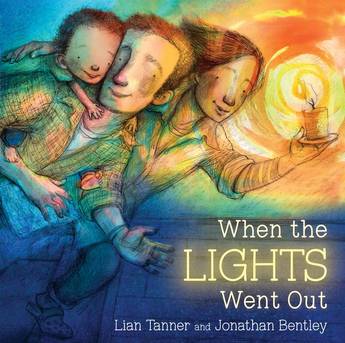
Your latest book is a picture book, When the Lights Went Out. What inspired this story?
When I was little, I was absolutely terrified of the dark. I think that was the very beginning of it, wanting to write a book that my much younger self would have found comforting.
Plus, last time the power went off, I became aware of how quiet the house was without all those tiny electronic noises that I don’t usually notice. It was as if it had become a completely different place, and that struck a little bell of interest in me.
What did you feel the main plot was going to be when you first thought of this book, and did it change at any stage?
It was always going to be about finding comfort when things are scary. But the first few drafts were more focused on how the world always turns and the sun always comes up, no matter how dark the night might be. I still really like that idea, but I couldn’t get enough out of it for a whole book, so I was pleased when the idea of a street celebration popped into my mind.
Winter-themed books are often focused on Christmas, but this one doesn’t reference it at all. Was this deliberate on your part, to evoke a sense of an Australian winter?
To be honest, it didn’t even cross my mind, probably because I don’t associate Christmas with winter at all. I did consciously want it to be an Australian story, but I also wanted it to be an inner-city story so that it could cross cultures. I think Jonathan did an amazing job of giving it an inner-city feel, with those beautiful little idiosyncratic houses.
This is the second book you have worked on with Jonathan Bentley – what was it like collaborating with him again after Ella and the Ocean?
Collaborating with Jonathan is one of the great delights of my creative life. Initially he didn’t think he could do this book because he was so busy, but when another possible illustrator didn’t work out, I begged my publisher to try him again, and he agreed.
I love his work so much. I love the unexpected ways he uses the page; I love the movement that runs through his illustrations, and most of all I love the sheer heart and warmth he pours into his characters.
Have recent events over the past four years inspired this to encourage people to reconnect with their communities?
The pandemic brought out both the worst and the best of humanity. I really liked the way people supported each other and checked on each other during lockdown, and how people found inventive ways to celebrate special occasions. That was certainly another element that went into the book, but it’s also a reflection of the small street where I live, which has always been a strong, friendly community.
The parents in this book turn their child’s fear of the blackout into a game and an adventure – was this inspired by a real-life event or did it come from your imagination?
I have no idea where this came from, so certainly not a real-life event. By the time I wrote it I had already been working on the book for a little while, coming back to it again and again in an attempt to discover where the story might go. I already loved the parents, and they seemed to me to be the sort of people who would turn something scary into an adventure.
Plus, I loved the idea of explorers giving each other piggybacks and singing brave songs!
Given most of your writing has been around fantasy, humour, and crime-solving poultry, what was writing a picture book with these themes like?
I don’t think it’s as different as it appears to be on the surface. Some of the themes that run through all my books are the importance of kindness, finding courage, finding family and community, finding joy. So, this is really just a more distilled version; a more focused version of what I usually write about.
To follow up, are any of these more difficult than the other, or do they all have their own challenges you encounter?
They all have their challenges. One of the big challenges with picture books is that, for me, good solid ideas are few and far between, whereas I’m overflowing with ideas for novels. But I like having the option of both, because the process of writing them is so different, and it’s refreshing going from one to the other. The big challenge with picture books, once I’ve got the story, is honing it down until there is not a word wasted. I find this takes a surprisingly long time!
Do you have a favourite genre to write?
I think fantasy will always be my first love. Fantasy plus humour has become a big favourite, because it’s so much fun to write, and that has become my main criteria – whether or not a book will be fun to write!
Did you always want to be a writer, or did you fall into it after trying other careers?
When I was a child, I wanted to be a writer, but I lost sight of that for a while in my twenties and thirties. I think a lot of people have dreams that get lost as they grow up, and not everyone is lucky enough to rediscover them. In my late thirties/early forties I trained as an actor/theatre worker, and that involved quite a bit of self-devised performance, which got me back into writing.
Of all the age groups you’ve written for, is there a favourite or one that you feel particularly drawn to?
I think my favourite is probably the Grade 3/4 age group. They are hilarious to work with and wildly creative, and I always love talking to them. I suspect the phrase ‘herding cats’ was originally aimed at Grade 3 kids.
Having said that, I also adore talking to the younger kids about my picture books, and the Grade 5/6s. They all have their strengths and delights.
Do you have a favourite character out of all the ones you have created?
So many favourites! At the moment, Snort, the horned glob in Fledgewitch, is high on the list. I have a soft spot for naïve characters, particularly when they are quite deluded about their own strengths/weaknesses. So Rita is another big favourite. Actually, I can’t think of a single character who I don’t love!
Your podcast 5 Writers, 5 Minutes is fantastic – what do you hope that people get out of it, and who do you and your co-hosts feel your main audience is?
Thanks Ashleigh, I’m so glad you’re enjoying it. We’re all busy people, so we wanted to create something that was very accessible in terms of time and information, something that people didn’t have to listen to for an hour to get to the good stuff. We also wanted to share some of the knowledge that, between us, we have accumulated over our careers.
We hope that it gives people an insight into the writing process, demystifies a lot of stuff about creativity, and encourages early career writers. When we started it, we aimed it mostly at teachers, to give them extra tools for working with their students. But we’ve found the audience is much wider than that.
Plus, we continue to discover interesting stuff about each other’s writing process!
You’re very generous with writing advice and connecting with readers – what is your favourite way to do this?
Pretty much any way it happens! I love running talks and workshops in person, because I get to see people make discoveries about their own writing, and to share my love of the writing craft. But I also try my best to answer the questions that young writers send to my blog or in letters. I’m currently part of the Author Penpals program set up by Kate Foster and Dee White, and that’s such a great way of making connections.
Finally, what’s next for Clara or the Dragons of Hallow, if you can tell us?
I honestly don’t know! I’m working on a couple of new things at the moment, but have no idea whether or not they’ll fit in with any of my previous series. I’d love to write more Clara, and more Hallow, but right now it’s all open ended.
Thanks Lian!
Discover more from The Book Muse
Subscribe to get the latest posts sent to your email.

 The Book Muse