NCACL Picture Books for Older Readers: Reading Pictures – Drawing Words
A Database of Picture Books for Older Readers
The latest database that the National Centre for Australian Children’s Literature has released is called Picture Books for Older Readers. Where the Cultural Diversity Database and the Aboriginal and Torres Strait Islander Database had specific focuses bit with a wider range of texts from picture books to novels, the Reading Pictures database of Picture Books for Older Readers is focused on a specific type of text – the picture book – that can be used in the upper primary and high school years of school.
This means that the themes are more nuanced than a general picture book database, so the books in the database might be longer, or deal with issues that are easier to explain to older children – issues and topics that older children might want to know more about, and if these topics are part of the curriculum, then these picture books aimed at older readers can introduce children in safe, accessible, and educational ways without talking down to then or having a dry presentation that might be present in text books.
Key Features
A few interesting features and details about the Picture Books for Older Readers database:
- It was launched on 1st July 2023.
- There are currently 241 books in the database, with 18 ready to upload at the time of writing this post.
- Like the other databases, it is a resource that will always be added to.
- It covers a broad range of topics for all ages.
Where the books came from
The books included in the Picture Books for Older Readers database came from:
- The extensive collection at the National Centre for Children’s Literature.
- Suggestions from children’s literature experts.
- Reading professional journals.
- Looking through bookshops.
What does each book’s entry have?
This is what most people will be interested in – what can they find when they search the database? First, when you arrived at the main page, you will see a grid of books, with a sidebar that has search options.
If you have a specific author or book in mind, you can use the simple search, which will also find a books if the keyword you use is in the annotations. I did a search for Jackie French using the simple search, and it turned up seven results (so far):
The result from a simple search for Cyclone is below:
Any result will look like this, and the drop-down menu under Annotation is Teacher Resources.
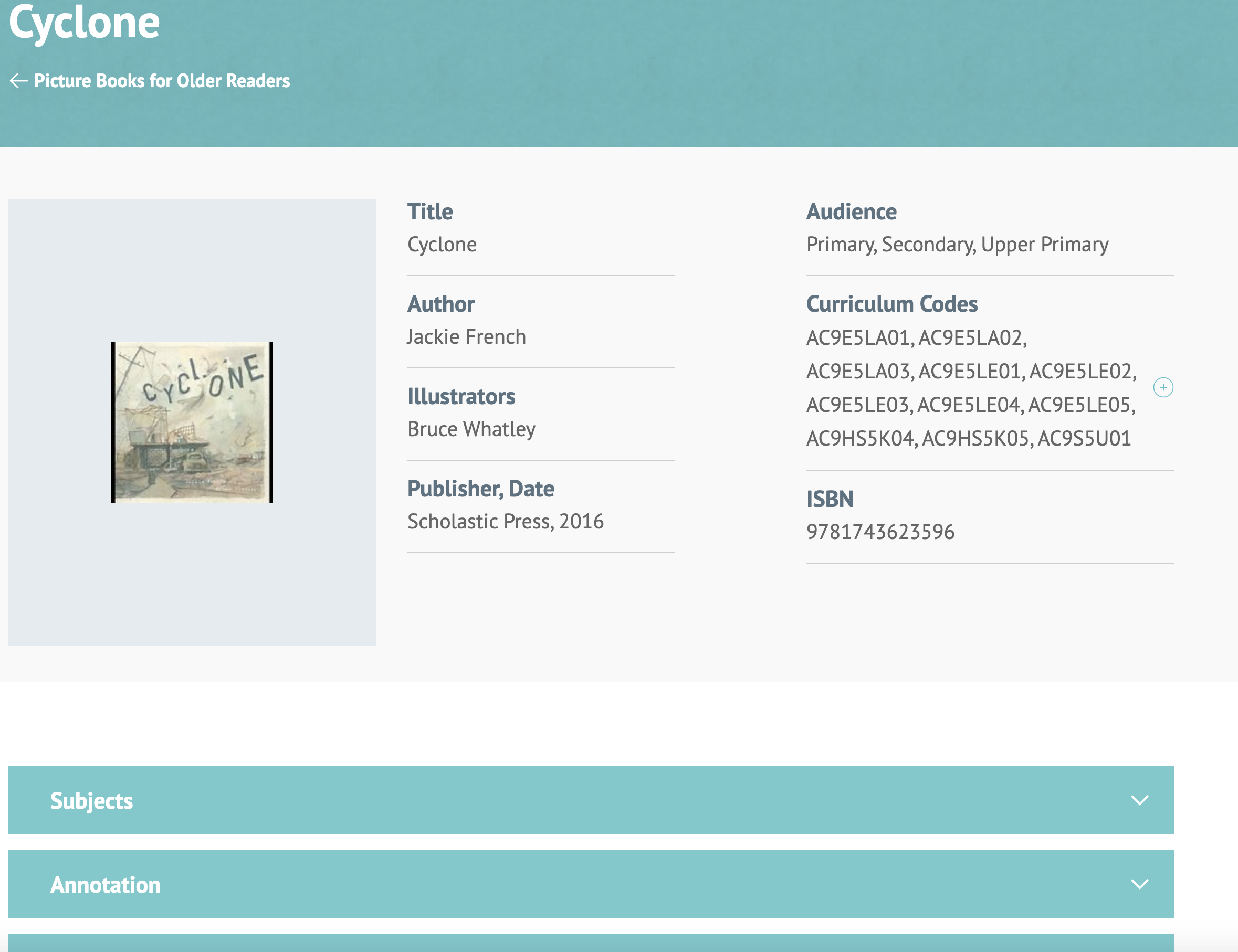
Teacher Resources include all sorts of links related to the book – reviews, information from the author’s website, and anything else that has links and relevance to the book. A simple search allows you to find an author, illustrator, publisher, and set dates to find a book depending on the information you have, and what you need from the database.
Advanced searching
To conduct an advanced search, scroll down and click show more. Here, you can select a subject, audience, enter a curriculum code if you have it, or an ISBN and find very specific information and books for your purposes. For example, a search for allegory under subjects gave me fourteen books to choose from, and this subject picked up a wide and diverse range of books as well.
An advanced search might look a bit like this:
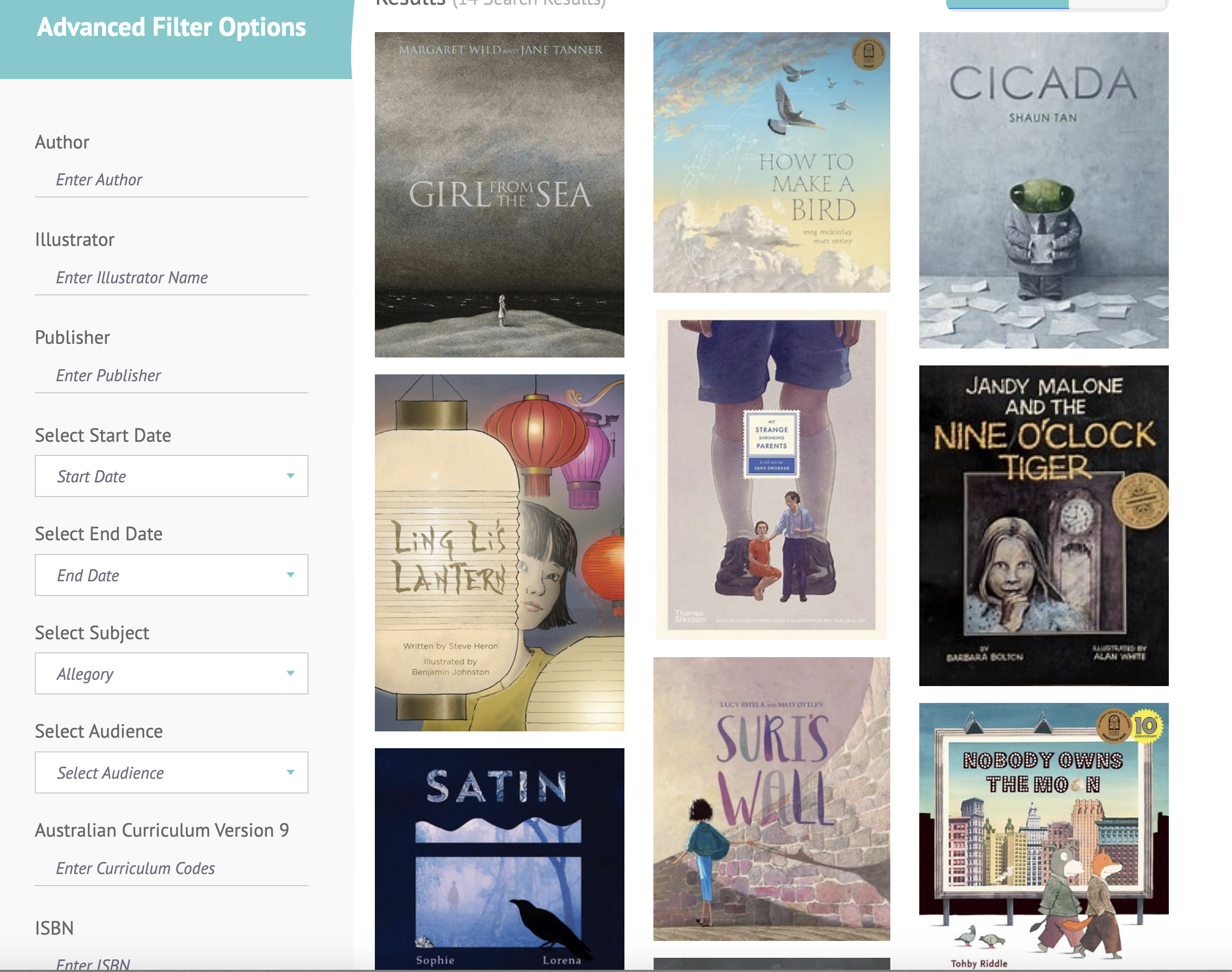
From here, you can choose a book to explore in a subject area like Allegory. I chose a few books to explore.
- An Anzac Tale by Ruth Starke – I chose this one because the ANZAC legend, Gallipoli, and WWI are one of the important moments in Australia’s history. It is something that everyone is aware about and will learn about at some stage, and there are many books that tell the story from a range of perspectives. This one is a little different – it portrays the characters as Australian animals and gives additional detail like maps and illustrations that show the ongoing impact that Gallipoli has had on Australia. There are many books that explore World War One in this database, as it is something that has had a huge impact on Australian history, art and literature, and there are many ways to write about it for w wide range of audiences.
- Drought by Jackie French and Bruce Whatley – This one explores impacts of climate change, specifically drought in this case. Whilst this book can be used to explain what a drought is and what causes it to younger readers, for primary, upper primary, and secondary students, it can be used to explore how drought is represented, talk about climate change, and what they can do. It would also be a good book to complement studies of climate phenomena or historical climate events, to give the facts context and a link to the human experience. I always found books that connected the human facet with the facts made studies more interesting.
- Heroes, Rebels and Innovators: Inspiring Aboriginal and Torres Strait Islander People from History by Karen Wyld – This picture book for olde readers also appears in the Aboriginal and Torres Strait Islander database, with some of the same subjects, and similar audiences and the same curriculum codes, so it can be used across a wide range of educational needs and classes, showing the diverse array of uses a book like this, and a picture book, can have. Karen’s book is filled with people many of us were not taught about in school and should have been. Her book gives all ages, from primary to upper secondary and beyond the chance to learn and build on our knowledge. Because it tells little known stories about Indigenous people, as well as talking about collaboration between Indigenous people and white Australians, it gives a deeper understanding to the accounts in text books. Books like this add to history, and allow more perspectives to have a voice, and to show that what we are told has gaps that need to be filled.
- The Giant and the Sea by Trent Jamieson and Rovina Cai – Rovina Cai’s book is definitely aimed at older readers and as the NCACL states on its entry, can be used across primary, upper primary and secondary classes. It touches on climate issues, something that is important in today’s world, so there will be many applications for this book in a range of areas. It can evoke emotions, allow readers to understand how to tell stories about climate change, or be used to explore how destruction can alter the world. It is one that I think older readers will get a lot out of.
- Radio Rescue by Jane Jolley – I stumbled across this one as I was scrolling through the pages. Set in a remote community in the early days of radio communication, Radio Rescue takes a smaller historical event, compared to war, and shows the very real, very human impact that it had on remote communities in areas like the Nullarbor. In a time when we take communication for granted, a story like this can show older readers how far we have come in quite a short time, and how revolutionary and important something like radio communication was many decades ago. It also incorporates the RFDS, so the combination can open up discussions about surviving in a remote community and the importance of technological advances like radio – and how this developed into the communications we have today.
There are many more books in the database, and more to come, so there will be something for everyone and every need.
Subjects
Like the previous databases, the picture books cover a wide range of subjects. These varied subjects offer insights into the stories and how they relate to the curriculum within schools for primary, upper primary and secondary schools, and therefore can be used to work out which areas of teaching the picture books might complement. Subjects can include:
- Fantasy
- Imagination
- Marine Life
- Visual Literacy
- Death
- Gallipoli
- Historical Fiction
- WWI
- Climate
- Biographies
- Discrimination
- Environment
- First Nations People
- Human Rights
- Law
- Language
- Racism
- Resilience
- Sustainability
Annotations
The annotations are very detailed, and give an overview of the plot, the elements of the story, such as the illustration styles, as well as whether it is part of series, the themes, genres, and subjects, as well as how the words and the illustrations work together, to give educators and guardians an idea of how they can use the book based on the curriculum codes at the top of each book’s page. The PBOR Database resource PDF file, available on the welcome page, states that the annotations allow anyone using the database to understand the context of each book which proved to be very useful as I explored the database, as there are some books that look quite different to what they really are, so this context can help a lot.
Teacher Resources
The teacher resources are in the third drop down menu, and often consist of interviews, podcasts, reviews, teacher notes from publisher websites, YouTube videos, and relevant organisational websites, such as the Australian War Memorial, the ANZAC Portal, or the NSW Department of Education, depending on the book and what is available for it. My reviews have been included for some books, such as Miss Franklin: How Miles Franklin’s Brilliant Career Began by Libby Hathorn, Rachel’s War: The Story of an Australian WWI Nurse by Mark Wilson, Song of the White Ibis by Phillip Gwynne, and Votes for Women: The Story of Nellie, Rose, and Mary by Mark Wilson. These varied resources those seeking to use the database a starting point to form lessons and research around, and might help students understand the book across a range of contexts, as each resource will focus on different aspects of the books which means they can be used in a variety of different ways. This will allow anyone
Who the Database is for:
- Teachers
- Librarians
- Parents
- Home schoolers
- Caregivers
- Secondary and Tertiary students
- Researchers
I studied children’s literature in university, and looking back, I think if I had known about this resource, or had come across it, I would have found it very valuable, especially if I had been writing about Australian children’s literature. It will help students looking at specific books or this area find things that will work well for their assignments, research, and is also good for understanding the wide range of children’s literature. I have definitely come across books that I didn’t know about before, and this has shown that the world of Australian literature is broader than we know.
What the database can do for us:
The database shows users the different characteristics of the books, the intended audience for each book, and all the relevant details. Because picture books can be used in many ways, the database of picture books has many purposes such as:
- Giving educators alternatives to novels, or books that can be read alongside the novels,
- Provide a list of books that can help find sources to work on image analysis,
- Shows that picture books can help develop multi-literacy and visual literacy,
- Promoting the analysis of different types of literature,
- It can introduce methods that can help decode the integration and words and pictures,
- Show how to analyse various artistic techniques, styles, book design and layout,
- Allow older readers to study literary devices and intertextual references,
- Examining multiple narratives,
- How to attract reluctant readers, EAL/D students, or those with learning difficulties to the world of reading in accessible ways,
- Illustrate books that feature non-traditional plot strictures, and metafictional devices,
- Help to examine sensitive topics such as death, war, violence, and societal issues,
- Give options to readers who find picture books suit their needs and interests, and,
- To provide useful tools in thematic units of work.
Analysis
Databases like this are wonderful because they are effective and useful tools for a range of needs. It ensures that there is a diverse range of choices, and allows educators, parents, guardians, librarians, or anyone who is involved in finding books for children to get their hands on what they need for the purposes of a class or based on the interests of the child they are trying to find books for. A database like this is so important – finding a book for a class or educational need, whether study, research, or analysis can be overwhelming, and I think if I had known that this centre existed or that there were databases like this when I was studying children’s literature at university many years ago, I would have made great use of it. It would have been a great resource to have had all those years ago because it has so many applications, and it can help you refine what you need. I liked starting with a theme or topic, because it helped narrow down a search when I wasn’t sure what I was looking for. It’s focus on Australian literature means that our literature is given a chance to shine and be explored in a range of reading settings across a broad audience who have vested interests in promoting and sharing Australian children’s literature. It is a resource that will be important and grow an awareness of the versatility of picture books.
Discover more from The Book Muse
Subscribe to get the latest posts sent to your email.

 The Book Muse