

Title: A is for Bee: An Alphabet Book in Translation
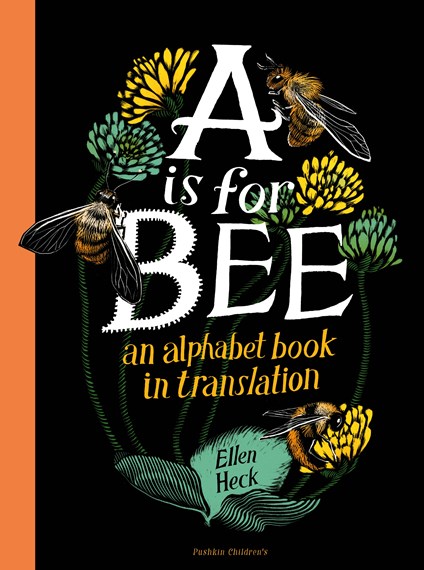
Author: Ellen Heck
Genre: Non-Fiction
Publisher: Pushkin Children’s Books
Published: 1st November 2022
Format: Hardcover
Pages: 40
Price: $24.99
Synopsis: “A beautifully illustrated multilingual alphabet book, to teach children about the amazing diversity of languages.
What letter does the word bee start with?
If you said “”B”” you’re right – in English!
But in many, many languages it actually starts with A.
Bee is Anu is Igbo.
Ari in Turkish.
Aamoo is Ojibwe.
And Abelha in Portugese.
Come and explore the gorgeous variations in the ways we talk about familiar things, unified and illuminated through Ellen Heck’s eye-catching, graphic scratchboard details and hidden letterforms.”
~*~
Bee starts with b, right? And cat starts with c? Maybe in English – but as anyone who has dabbled in languages of any kind knows, this is not the case. Sometimes, yes, the first letter may be the same, however, in many cases, it is not so. Most alphabet books use Bee for B, Cat for C, Dog for D, and so forth. But lately, there have been many picture books coming out that include two or more languages on the page. For the ones I have read, it has usually been English and an Indigenous language, or a novel that is mostly in English but with a smattering of words in another language in it. The latest I have read is an alphabet book, where the most common animals we find in most alphabet books are used but in a different way. In this book, the letter we associate with animals like cat, tiger, or zebra are different – and Ellen has researched these languages to find the right word and worked with a team to get the right spelling and work on a pronunciation guide accessed by a QR code at the back of the book.
As I have studied languages at school, I was able to sound out some of the words, and others I knew from my studies at school. For French, Indonesian, and Japanese throughout primary school and high school. This book invites us to learn words and languages we’re not familiar with, and I think is a good introduction to as many languages that Ellen could find and utilise. Readers of all ages, not just younger children will learn words in Native American languages, Asian languages, and European languages – at least, in terms of what words have been found to match up with the animals that were chosen.
Some animals have more words than others, which makes sense because not every language will assign the same letter to every animal. For example – a tiger is harimau in Indonesian, so the letter ‘H’ is assigned to tiger. A language, therefore, that doesn’t have their word for tiger starting with h is not included, however, I think this book is just the start – one can take what is written here and investigate the names and words other languages use for animals. Cat is G in this book – Gato, but to prove my point, a cat is kucing (the c pronounced like ch) in Indonesian, and from memory, the word for cat in Japanese starts with an n. So this book is a great to introduce children to the concept of languages and as a way to show them what different languages look like – for some, it will be in transliteration if the language has its own alphabet – as Ellen has used the English alphabet to create the book. But it won’t be hard to look it up and take note of what the other alphabets are once you have read the book. It is such a great book to begin an enriching educational experience and I think readers of all ages will engage with this and enjoy it.
Discover more from The Book Muse
Subscribe to get the latest posts sent to your email.

 The Book Muse
1 thought on “A is for Bee: An Alphabet Book in Translation by Ellen Heck”