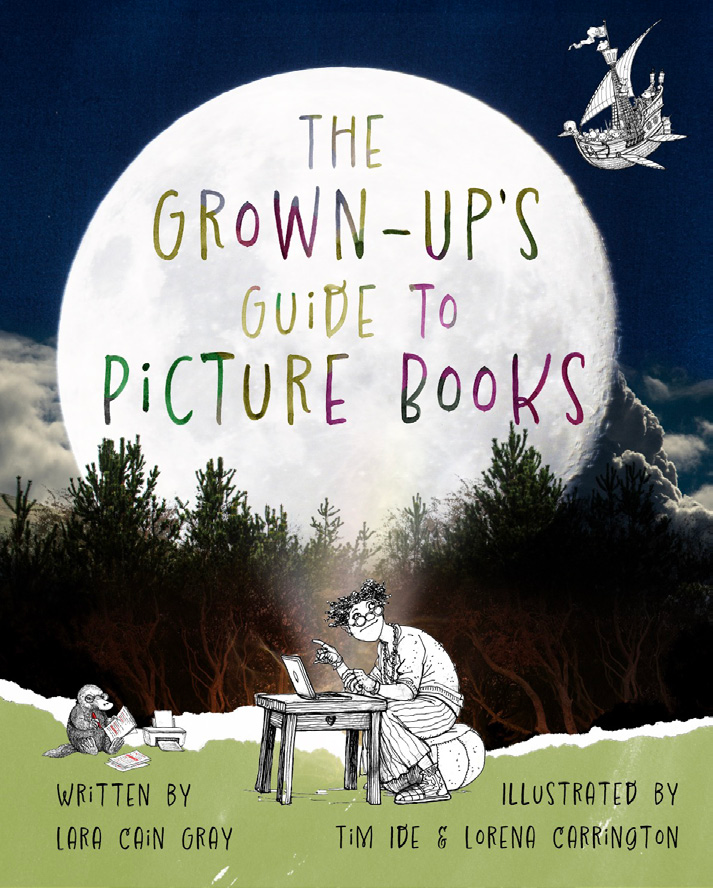
Title: The Grown-ups Guide to Picture Books
Author: Dr Lara Cain Gray, illustrated by Timothy Ide and Lorena Carrington
Genre: Non-Fiction
Publisher: Midnight Sun Publishing
Published: 1st September 2024
Format: Hardcover
Pages: 64
Price: $34.99
Synopsis: A picture book is a book with pictures, but it’s so much more than that! This A-to-Z guide helps you level up your picture book reading experiences, empowering yourself and the young readers in your world to dive deeper into what makes a great picture book great. With histories, insights and handy talking points for shared reading, come and explore the complexities of modern picture books. Discover the science of page layouts, the purpose of rhyme, and why our favourites linger in our hearts and minds for life. Let’s read!
~*~
Picture books are amongst the first stories we hear and read – but how much do you know about them? Most people would see them as simple stories for children. However, if you look a little further, they’re much more than that. They’re vehicles for identity, education, and literacy as well as fantastic stories that stay with us for years to come. In this fantastic new book, Dr Lara Cain Gray, a children’s book specialist has written a fabulous new guide to picture books for adults that explores 26 aspects of picture books. She uses her knowledge of children’s books, writing, storytelling advocacy, and her experience as a librarian and in museum curatorship to tells the story of picture books using the alphabet. She explores the elements associated with each letter, and goes in-depth to give readers an idea what they are about. She then accompanies them with exercises to do with picture books, and tips about how you can explore them.
Lara’s educational text is accompanied by collaborative illustrations from Timothy Ide and Lorena Carrington, which help bring the elements to life, but at the same time, illustrate how pictures and text work together in picture books. In a typical picture book, the illustrations are related to the story, or help to tell the story. They’re populated by characters, settings, or other elements that fill in the gaps, or help tell the full story. Many picture books don’t have more than 500 words – so the pictures are essential to help tell the story. The text is longer in this book, but the pictures are still important. Rather than helping tell a story, because this is a non-fiction book, they collaborate with the text to reflect on each letter and the aspect of picture books they explore.
Having studied children’s literature many years ago, I came to understand what elements could be used to create a book that children loved. I mainly focused on middle grade and young adult stories, fairytales and nonsense stories, however, picture books are just as important. Reading this book made me wish we’d examined more picture books and more Australian authors in that course. As a result, much of my education around picture books and Australian children’s literature has been self-taught through reading and now, books like this. This is a book that celebrates picture books and shows how important they are in the wider canon of children’s literature.
The wonderful thing about this book is that it is accessible to everyone who has an interest in picture books beyond simply reading them with children. It gives people the tools they need to understand the layers and nuances of picture books, whether it is the role of endpapers, and how they can be part of the story, to the role of genre or certain characters, to the role of repetition. Repetition, as Lara explores it, is one of the elements that make a picture book stand out for children. Repetition can be used to reinforce language and story for children, which by extension can help them build their vocabulary and listening skills. In exploring the way picture books can help teach children as well as show them the diversity of the world around them and beyond. And perhaps most importantly, shows readers that picture books are definitely for all ages (yes, even Macca the Alpaca)!
I also liked that it explored aspects of stories that are present in all books, yet geared them towards picture books. Of course, I did feel that this was information that could be applied to any book as well. Lara explores the role of narrative structure and opening lines, and what they mean in picture books. Picture books have less time and fewer words to catch our attention – so they need to grab the reader from word one. Lara puts in the narrative structure – which can be used for any story, and this is one spread that will be very useful to authors and those aiming to get published. It shows the basic story elements and the conventional Western five-point-arc in picture books. These are things that I studied in my writing courses and that I have learnt through doing as well, but there is something about seeing it set out in a book like this that shows how the elements work that makes it click for writers.
And, the power of opening lines is what hooks the reader, hauling them into the story. It’s what makes us want to read on, because we want to know what comes next. And a good opening line can set the tone for what is to come. It gives readers an idea of the story, perhaps even before we get to the illustrations.
The Grown-ups Guide to Picture Books is a testament to the collaborative nature of picture books. You have an author, and an illustrator, or in this case, illustrators. Timothy Ide’s line illustrations have been merged with Lorena Carrington’s layered photography and art, and this shows how different illustrations and illustration techniques, as well as design, can give the book what makes it succeed. I felt that the way this trio worked together has created an exceptional text that will be read and re-read. It is also the kind of book that is not just for those who are interested in knowing more about picture books or for those who work in the industry.
This book is perfect for those studying literature or education at university, as it unpacks and explores how picture books influence us in an informative and entertaining way. I may be biased, but my favourite illustrative elements were from Lorena – and I was very drawn to the magic illustration. That was my favourite of them all! It is illustrations like this that speak to us that I think are what can make a picture book succeed as well.
It is the type of book that I feel would have been useful when I was studying children’s literature and creative writing. There are lots of ways this book can be used in an educational environment, particularly for adults who have an interest in picture books. Everything in this book is written in an accessible way as it explores and celebrates the role of books, language, and picture books in our lives. I think it would be a great assigned text alongside fiction books and other texts to explore how picture books can be used, or if used in high school, it can help students build their lifelong literacy skills that they can take into any reading that they do throughout their lives.
Picture books are important texts in our lives, and they are something for all readers, not just children. It is a book that I will keep on hand, because I feel it can help me in all my reading and writing, and I hope this team has more to come in this area. I’m sure there are many other areas that they could explore.
Discover more from The Book Muse
Subscribe to get the latest posts sent to your email.

 The Book Muse
interesting.
LikeLike