
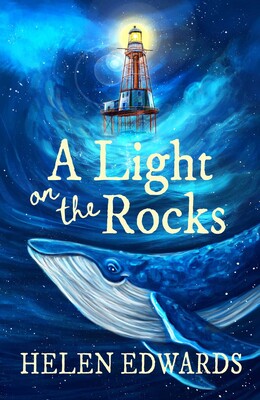
Title: A Light on the Rocks
Author: Helen Edwards
Genre: Historical Fiction
Publisher: Riveted Press
Published: 28th January 2026
Format: Paperback
Pages: 224
Price: $17.99
Synopsis: In 1859, fourteen-year-old Daisy is travelling on the SS Admella from Adelaide to Melbourne, when the steamship is wrecked on a submerged reef near Cape Banks, in what became known as one of Australia’s worst maritime disasters. A century later, siblings Max and Rose spend their summer holidays at Cape Jaffa Lighthouse, perched on a reef, eight miles out to sea, where their father is head keeper. While exploring the reef, they encounter a ghostly horse—one of six aboard the Admella when it went down.
As they unravel the secrets of the past, an accident leaves their father and the assistant keeper injured, and Max and Rose are left to care for them while also ensuring the lighthouse keeps burning through the night. Set across two timelines, connected by place, mystery, and magic, A Light on the Rocks is a haunting tale, about survival, self-belief and the wild beauty of the sea.
With a ghost horse, a singing whale, and real events woven through the narrative, this is a masterful maritime adventure that brings the almost-forgotten history of the SS Admella and the Cape Jaffa Lighthouse to life.
Helen was awarded a mid-career fellowship with the South Australian State Library, supported by Writers’ SA, along with a grant from the South Australian History Trust to research and write this beautifully crafted tale.
~*~
1859, Daisy and her family are on the SS Admella from Adelaide to Melbourne when, merely a day into the trip, the steamship is wrecked on a reef near Cape Banks. In 1959-1960, Rose and her younger brother, Max, are staying at Cape Jaffa Lighthouse with their father for the summer holidays. Yet, as they go about their days, Rose coping with asthma, and Max grappling with dyslexia and dysgraphia at a time when these conditions weren’t recognised as they are today. But Rose and Max are more focused on exploring Cape Jaffa. One day, they discover the ghost of a horse, which leads them to find out more about the Admella.
In the 1859 chapters, Daisy is amongst the few who didn’t go down with the ship, clinging onto the wreckage and hoping for someone to notice, for someone to come and rescue them. The devastating cold throttles them as Daisy story unfolds alongside Rose and Max’s story, who are left to keep the lighthouse running after their father and his assistant are injured.
The stories come across as two parallels in different times, but with similar circumstances about survival, bravery and isolation in a cold, windswept place on a reef. Daisy and her family are gripping to life and survival for the days they are trapped on the wreckage, waiting for help. Waiting for someone to notice or for word to get out about what has happened. Just like Max and Rose, she’s got no way of letting anyone know, no way of doing anything except survive. And in 1960, Rose and Max do what they can until they’re able to send a message over the radio and while they wait for the other lighthouse keepers. It’s hard, but Rose and Max have each other, and they know they can do it. They use the best of themselves and their skills to do what they can, and at the same time, find the bravery to do the things that have scared them or the things that they feel they can’t do. The things that seem to be holding them back in the eyes of so many people at school.
A Light on the Rocks is another historical fiction triumph from Helen Edwards exploring tragedy, disability and strength in dire circumstances. It looks at the strengths the characters have and the reality of how they dealt with or coped with their disabilities in the 1950s and 1960s, a time when there was a lot less understanding about disabilities than we have today. It’s a powerful reminder of how far we have come, how far we have to go, and how often, at least for Rose and Max, it was the people they spent the most time with who were able to help the most. They understood each other, they knew how to help and support each other. Their relationship was wonderful, because I could see how they were always going to be there for each other.
And the tragedy of the Admella reverberates throughout the book, not shying away from what happened to the people and horses. But it also manages to tell these dual time lines sensitively and in age-appropriate ways for readers aged ten and over. It’s tragic and hopeful in equal parts, bringing one of Australia’s worst maritime disasters to life for a new audience, and for readers and people who may never have heard about it before. It may not have been one of the big events in Australia that shaped the country, but it had its influence, particularly on the people who were affected and their families. This is another excellent historical fiction book from Helen Edwards dealing with tragedy, disability, hope and overcoming fears to prove that our limitations and disabilities, whilst part of who we are, do not define us. It sits well alongside Helens other books, and kids who have some of the struggles the main characters do, or have had, will be able to see themselves in these characters and the story.
Books like this teach us about history, the world and experiences beyond our own. They allow people to see themselves in books, and start conversations about tragedies or how disabled people managed before their disabilities were understood. Or how people travelled before fast transport. Books open up worlds that we don’t have access to, or the past. They teach us something, and that is what makes them so powerful.
Discover more from The Book Muse
Subscribe to get the latest posts sent to your email.

 The Book Muse
3 thoughts on “A Light on the Rocks by Helen Edwards”