Title: Sister Viv
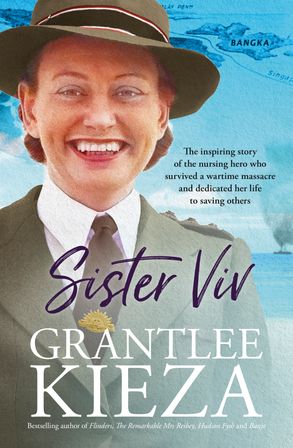
Author: Grantlee Kieza
Genre: Biography/History
Publisher: ABC Books
Published: 3rd April 2024
Format: Paperback
Pages: 352
Price: $35.99
Synopsis: The inspiring story of the nursing hero who survived a wartime massacre and dedicated her life to saving others – from the critically acclaimed, bestselling author of Flinders, The Remarkable Mrs Reibey, Hudson Fysh and Banjo
Bangka Island, 1942: Australian Army nurse Vivian Bullwinkel was just twenty-six when Japanese soldiers marched her and her fellow nurses into the shallow waters of a remote beach to be executed.
Miraculously, Vivian would be the lone survivor – and she committed the rest of her long life to an exceptional peacetime career which she lived in tribute to her lost friends. The Lieutenant-Colonel would also be the first woman to be honoured with a statue at the Australian War Memorial for her extraordinary bravery and service – a country girl who become one of the highest-ranking women in the Australian army, and who spent her life caring for others.
Growing up in Broken Hill, New South Wales, Vivian started work at a local hospital and joined the Australian Army Nursing Service in World War II. When the Japanese attacked Singapore in 1942, she and sixty-four other nurses were ordered to evacuate, but soon their ship was bombed by enemy aircraft. Some of the women drowned, but Viv made it to Radji Beach on Bangka Island, off Sumatra, with twenty-one of her nursing colleagues.
There Japanese soldiers forced the women to wade back into the sea, and as Vivian felt a bullet slam into her back, she fell face down into the water then waited to die as the soldiers bayonetted survivors. Somehow Vivian lived.
For the next three and a half years Viv was a prisoner of war in a series of brutal Japanese camps where she helped other inmates survive the horror. When peace was restored, she went on to become a giant of Australian nursing – and was a key driver of Operation Babylift, the mass rescue of young orphans during the Vietnam War. For her extraordinary efforts, Vivian was awarded numerous honours, but she never forgot her fallen colleagues, whose lives she paid tribute to with her service to nursing.
From the bestselling, critically acclaimed author of Flinders, The Remarkable Mrs Reibey, Banks and Hudson Fysh, Sister Viv tells the astonishing story of the courage, sacrifice, service, and love of an Australian nursing hero who survived against the odds and dedicated her life to the care of others.
~*~
In 1942, as World War II raged on, the evacuation of Singapore had begun, trying to get civilians and nurses out of danger as the Japanese made their way towards Australia amidst the bombings of Pearl Harbour and Darwin several months apart. Ships left Singapore with nurses and those well enough to travel. Yet, not all ships made it to Australia. The ship Viv was on, the Vyner Brooke, was bombed. And this is where Vivian’s story of survival begins. Washed up on Bangka Island, Vivian and the surviving nurses were forced into the shallows of Radji Beach and shot – only Vivian, aged twenty-six, survived.
After this, she spent three and a half years in brutal camps on Bangka Island and Sumatra, where they were treated mercilessly and brutally in the camps where she worked to help other prisoners survive – civilians, children, soldiers and her fellow nurses, watching as many succumbed to injury, illness and starvation. Her story is one of survival and endurance, the fight of the human spirit to endure in harsh conditions that contravened the Geneva Convention for prisoners of war. Grantlee Kieza, using historical records, the official story of what happened, and in collaboration with Vivian’s family, relates what happened through diaries, letters, the facts known about what happened, and a little bit of creative licence to make it engaging yet harrowing, dark, and realistic, has managed to tell Vivian’s story respectfully.
Vivian and those she was with in the camps experienced brutal treatment under the Japanese, but at the same time, Vivian’s experience and those of others touch on the range of ways they were treated – that where one Japanese soldier could be cruel, another on a different day might be a bit fairer in comparison. Vivian, the first woman to be commemorated with a statue at the Australian War Memorial, often saw these contradictions, understanding that she was lucky to survive. Acknowledging the brutality, what happened, the experiences of Vivian and the others alongside the fact that amongst the awful treatment, there were glimmers of hope and luck in which Japanese soldier one might deal with or what a day might be like highlighted that the full story always encompasses a range of experiences, thoughts and opinions.
But at its heart, this book is about Vivian and her strength in the face of adversity, and when she got home, in the face of a war crimes tribunal, where an order from the government kept something significant from the official record – something that Grantlee’s book touches on towards the end – because Vivian Bullwinkel wanted to tell the truth, to make people understand what had happened and to let the families know as well. The gist of this section of the book and the ABC article above hint at Viv wanting to tell the truth, yet being censored. I felt Grantlee had done his due diligence with research as far as he could – with footnotes and a bibliography for people to follow up with their own research. I didn’t feel that this was embellished – the horrors that Vivian and her fellow nurses would have experienced need no embellishment or expansion. We get a sense of the smells, the sights, and everything from the simple, yet expressive language that evokes what the time in the camps was like.
I also found the wider context around the war, the nurses families, and Vivian’s family worked well too, because it gives reader an idea of what the nurses missed out on, what the families were unaware of until the end of the war and when the nurses were found, and what this ultimately meant for the story and stories that would be told, and in some respects, be allowed to be told on the official record. Years after the war, Vivian would return to a warzone to help with Operation Babylift to evacuate orphans from Vietnam – showcasing her dedication to nursing, humanity and helping people get to safety and survive, just as she did during her years in captivity.
Biographies like this, moving through what happened and the subsequent years and revealing the things that were censored or kept from the public let the public know what really happened and can add to the historical record. Yes, there is a narrative sense about this book, but often, biographies rely on some aspect of narrative devices to turn the facts and figures into an engaging and informative story. The best ones do this without over fictionalising or over sensationalising someone’s story. And reading this, I felt like there was a good balance between telling a story and using the facts without going too far over that edge. Of course, there are many questions that cannot be answered, and that may never be answered. The stories, the truth that we know may have to suffice at this stage. But what matters is that Grantlee’s biography allows readers a glimpse into Vivian Bullwinkel’s life, from what she went through to new revelations that hint at more than what is known – yet what this book and the above article suggest is that we do need to be careful to read into things too much – something may have happened, but it also may not have – we can only work with what has been revealed and in some cases, what is on the official record if someone has been censored or been unable to tell their story publicly as Vivian had to do.
Ultimately, I found this book to be informative, and gives the more stories to Australia’s World War II narrative. It is also bringing Vivian to a wider audience than those who may not know much about her, and I think it would be interesting to have read about this story from Vivian herself as well. And this book will hopefully add to her story and legacy about the war and truth about what happened.
An interesting and compelling read, as I wanted to find out who would survive alongside Vivian at the end of the war.
Discover more from The Book Muse
Subscribe to get the latest posts sent to your email.

 The Book Muse
5 thoughts on “Sister Viv by Grantlee Kieza”