
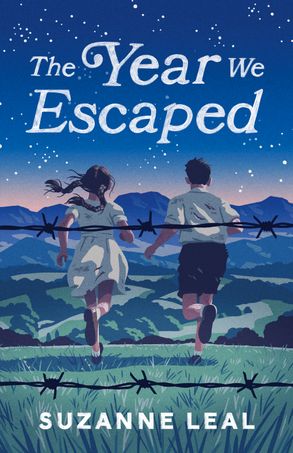
Title: The Year We Escaped
Author: Suzanne Leal
Genre: Historical Fiction
Publisher: HarperCollins Australia
Published: 4th June 2025
Format: Paperback
Pages: 352
Price: $17.99
Synopsis: For fans of Jackie French and Katrina Nannestad, The Year We Escaped is a heart-stopping and remarkable World War II story by talented author Suzanne Leal.
Europe, 1940
With war on their doorstep, German classmates Klara and Rachel, and French brothers Lucien and Paul, are forced to leave their homes. They are taken to Gurs, a French detention camp in the south-west of France. It’s a crowded place, with little comfort and even less food.
When Klara and Rachel are promised safe refuge in a remote French village, Lucien and Paul are anxious to join them — and will risk their own lives to get there.
Filled with adventure, danger and intrigue, this is the story of four unlikely friends desperate to escape from a war that keeps coming closer.
~*~
In 1938, Klara Gold and her mother live through Kristallnacht in Germany, and from there, are subject to discrimination as Jews. Klara has to change schools. Her mother loses the family business, and in 1940, they’re taken to Gurs, a French internment camp for enemy aliens along with many other Jews, including one of Klara’s friends, Rachel.
In Paris, around the same time, Paul and Lucien find out that their mother is Jewish, and they go on the run with her – only to be sent to Gurs as well. In Gurs, they meet Rachel and Klara, and attend the camp ‘school’ with them until Klara and Rachel are taken away to safety in a remote French village – safety until the end of the war. But Lucien and Paul aren’t so lucky. But the boys are willing to risk everything to escape Gurs and get to their friends as war encroaches on their lives and threatens everything they love and know.
Many World War Two novels I’ve read have focused on aspects of the Holocaust, resistance movements in Germany and France, or the Australian experience on the home front or in internment camps in Singapore and other Japanese-occupied areas at the time. In Suzanne Leal’s latest, the characters are in a camp that at first, felt different to the camps many people know the names of. Gurs was the first and largest camps in France, established before the war. During the timeline of this novel, it serves as a detention camp for ‘enemy aliens’ from Germany and Vichy France – before many were sent to Auschwitz.
For Klara and her friends, being in the camp is cruel and they’re facing the cruelty of a world that has started hating them. The children are confused – what have they done? Why are people who were once polite to them now awful? Klara and Lucien feel bombarded with these questions as they navigate their new normal, and find out that some people want to help, where others want to harm them – just because of who they are, because they are Jewish. The four children at the centre of the story are innocent, they’ve been taken away from their homes and forced to live in cramped conditions – conditions that they nor anyone else should ever have to experience. Setting it in a camp that was, at first, not connected with purposeful extermination gives the story a different feeling – for the characters, who are unaware of what is to come, there is almost a sliver of hope that they will be reunited eventually, and that things will end. But for readers, who might know a bit about what is to come, it can be read in a bittersweet way. There is a sense that we know what fate will await their mothers who are still in Gurs. A trepidation of knowing what is to come from the years beyond 1941, and how this will change everything for the characters. And there is a sense of relief that the children will survive, tinged with sadness because as a reader, I could guess what they might be facing in coming years.
For Klara, Rachel, Paul and Lucien, there is hope throughout the story, and that is what they hold onto, to keep themselves going and help themselves heal, or at least, start to heal and work out what the rest of their lives during the war might look like. The characters were such a joy and interesting to follow, with clear voices and emotions that evolve throughout the novel and give the story a gravitas and message that reverberates through to everything that is happening today across the world, reminding us that it is important to stand up for what is right and not discriminate against people for something out of their control. It also serves to show that people will do anything to survive, and that when things get desperate, people will do anything they can to save their children.
Books like this remind us that we should not repeat the bad things that have happened in the past. And if similar things are happening again, we should do what we can to speak up. Because some of the themes in these stories feel like they are repeating today. That tolerance is changing and that the world has not learned its lessons from the past. History should show us what not to do. The world is still in turmoil today, just in different places.
Suzanne Leal shows us that compassion is what can change the world, even if it is in small ways, that friendship can get us through, and about the importance of paying attention to the world around us.
Discover more from The Book Muse
Subscribe to get the latest posts sent to your email.

 The Book Muse
7 thoughts on “The Year We Escaped by Suzanne Leal”