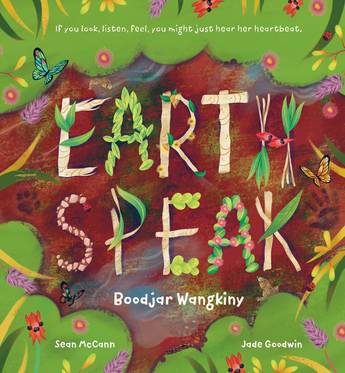
Title: Earth Speak: Boodjar Wangkiny
Author: Sean McCann, illustrated by Jade Goodwin
Genre: Fiction
Publisher: Allen and Unwin
Published: 3rd June 2025
Format: Hardcover
Pages: 32
Price: $26.99
Synopsis: A joyful story celebrating the natural world, the sharing of culture through Noongar language and the awe that comes from seeing, hearing and feeling how elemental forces shape the earth.
Papa says we’re going to a special place today.
‘If we djinang (look), ni (listen), goordoo (feel), we might hear boodjar wangkiny (earth speak). We might even feel her heartbeat.’
I wonder what that will sound like? Will the earth’s heart beat just like ours?
A bush walk in a stunning landscape becomes a heartfelt invitation for children to engage with their senses, care for the environment, and learn some Noongar language words along the way.
An earlier version of this review appeared in Good Reading Magazine in July 2025.
~*~
The past few years have seen some really cool picture books by Indigenous authors coming out that feature language, culture and stories about connections to Country. Each one is different, and each one captures something beautiful about the First Nations people, languages and cultures.
The simply told, yet very emotive picture books are very effective tools to incorporate what we don’t know into books and education. One of the latest books in this area is Earth Speak: Boodjar Wangkiny by Sean McCann, where much of the story is in English, but Sean has used Noongar words for look ( dijnang), listen (ni), feel (goordoo), earth (boodjar), water (kep), fire (karla), wind (marr), and earth speak (boodjar wangkiny) to bring Country to life. It celebrates a connection to culture and Country through language, but does so in a way that many readers can understand. This is important because if we are to move towards working together, finding ways to understand each other and connect with things we may not have known about in the past is a good way to help us get there.
The Noongar language, culture and connection to Country ebbs and flows in this book as Papa teaches his family about earth speak, and what it means to understand what the earth is trying to tell us. The earth speaks to us in different ways, and this book will take readers on a magical and insightful journey about what the earth is trying to tell us. So, sit and listen to the earth as it speaks to you. Listen to Country on all your adventures and learn its history and stories, just as Sean’s characters do.
I said it in my introduction, but it is worth repeating. Picture books like Earth Speak that explore intersections of culture, language, environment and Country are a great resource. They allow us to see how everyone interacts with the earth and what it means in different cultures. In this one, we get a great glimpse at Noongar language and culture with the important words relating to the story highlighted in the prose and at the front of the book to reinforce the chance we have to learn a bit more.
Using languages – any languages – in a context that relates to them is a great way to learn a new language. Because we see how the words relate to things and what they mean respectfully. It also means that people can go off on their own and find out more if they want, such is the power of picture books.
This is also a very accessible picture book that anyone can read, learn about language and Country, and just enjoy a story with an enduring message. The Noongar words are woven into the prose and Country, and something I have noticed in a few books that incorporate Indigenous is a QR code at the front or the back. This means readers can listen to the story as well as reading it and understand the flow of Noongar language to get a better understanding of this book.
It is the opening up of culture and language to more readers that will help it to thrive for years to come, and create better understanding and appreciation of Indigenous culture.
Discover more from The Book Muse
Subscribe to get the latest posts sent to your email.

 The Book Muse
1 thought on “Earth Speak: Boodjar Wangkiny by Sean McCann, illustrated by Jade Goodwin”